

GPT-6.1 Terra has arrived with a practical proposition: understand visual material, operate software and complete professional tasks at a lower cost. Its release also highlights why a single leaderboard position cannot capture speed, reliability and cost differences between AI models.
What GPT-6.1 Terra changes
OpenAI positions Terra as a balance between performance and price for everyday professional work, from reviewing materials and drafting proposals to navigating interfaces and completing repetitive operations. Compared with GPT-5.6 Terra, the company reports improvements in visual understanding, software use, coding and factual accuracy.
For communication and creative teams, the important shift is from generating an answer to completing a verifiable workflow: reading a screen, taking an action, checking the outcome and reporting any limitations.
What the benchmarks actually show
On Agents’ Last Exam, OpenAI reports a 15-percentage-point improvement over GPT-5.6 Terra at medium reasoning effort and roughly one-third of the cost. Under that evaluation, Terra matches GPT-6 Astra at one-tenth of its per-token price. These comparisons describe specific test conditions, not universal superiority.
On OpenAI’s internal error-inducing prompts, the low-effort factual error rate fell from 53.6% to 16.7%. On Terminal-Bench 4.0 at maximum reasoning, GPT-6.1 Terra solved 50.3% of tasks, compared with its predecessor’s 21.5%. The results are meaningful, but no single benchmark predicts performance on every business workflow.
| Measure | GPT-5.6 Terra | GPT-6.1 Terra |
|---|---|---|
| Factual error, low effort | 53.6% | 16.7% |
| Terminal-Bench 4.0, maximum effort | 21.5% | 50.3% |
| Standard API price | Higher | 50% lower according to OpenAI |
AI model comparison: what does a top-ten ranking mean?
Marketing4eCommerce reports that GPT-6.1 Terra entered tenth place on Artificial Analysis’s Intelligence Index, behind GPT-6.1 Sol. That ranking is a dated snapshot, not a definitive answer to which model a business should choose. New releases and methodology changes can alter positions.
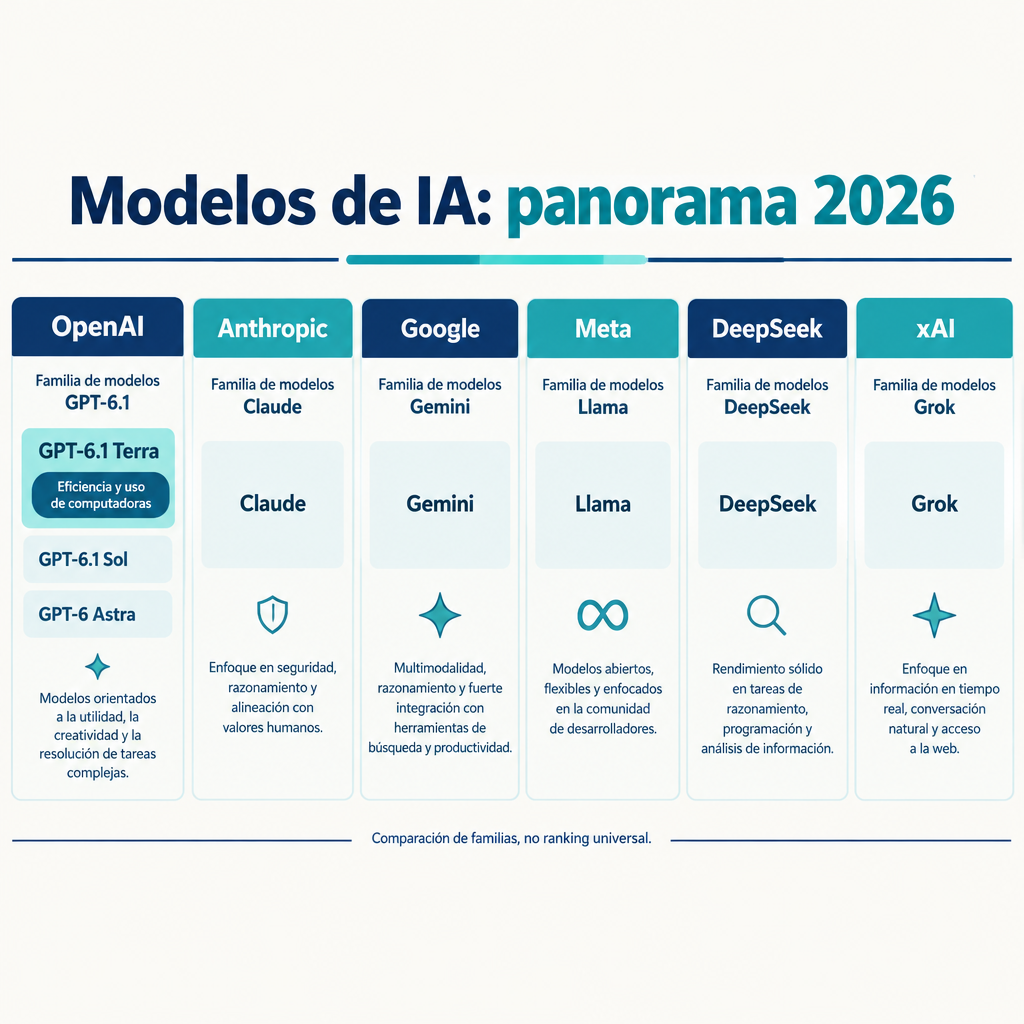
The wider market includes OpenAI’s Terra, Sol and Astra; Anthropic’s Claude family; Google’s Gemini; and models from providers including DeepSeek, Meta and xAI. Capabilities and prices depend on the precise version and workload. General intelligence rankings, computer-use benchmarks and cost-per-task measurements are not interchangeable.
Implications for communication, marketing and video production
Communication teams can test Terra on presentation reviews, asset classification, quality checks and administrative workflows. In VideoMarketing, its potential lies in reading interfaces and visual sequences, building time-coded logs and following defined editing procedures. Strong benchmark results do not mean that every audiovisual project can be completed without human review.
For a related perspective, see our article on Gemini and digital coworkers. A practical pilot might involve examining ten campaign assets, flagging cropping or text issues, logging observations and verifying which corrections were useful. This measures quality, review time and cost per completed deliverable rather than the number of generated responses.
Pricing and availability
OpenAI lists standard API prices of $1 per million input tokens, $0.05 per million cached input tokens and $5 per million output tokens. API billing is separate from ChatGPT subscriptions. In ChatGPT, Terra is offered in eligible Work and Codex experiences, not the regular chat model selector.
Cost per token should not be confused with cost per finished task. A cheap call may become expensive after repeated attempts or extensive review, while a higher-priced model may be worthwhile when it produces reliable results. OpenAI still recommends Sol or Astra for particularly complex research and coding work.
Automation still requires editorial judgment
Better models do not eliminate factual mistakes, visual misinterpretations or malicious instructions. For communication and audiovisual work, teams should verify outputs involving data, brand assets, third-party images and public-facing decisions. Responsible adoption combines clear scope, restricted permissions, human checks and measurable outcomes.
The takeaway: GPT-6.1 Terra is a step toward more practical AI for everyday work. Its lasting value will depend less on its leaderboard position and more on how reliably and affordably it fits real processes.
Frequently asked questions
Is GPT-6.1 Terra available in regular ChatGPT?
No. Announced access is through eligible ChatGPT Work and Codex plans and the API.
Is it the world’s most intelligent AI model?
That cannot be concluded from a single leaderboard. The cited news source places it tenth on one index; other tests measure different capabilities.
Can it edit videos autonomously?
OpenAI highlights visual understanding and computer use, but professional editing still requires workflow testing, material review and export validation.
Sources